May 25-29, 2026
Edinburgh, Scotland
About EdMedia

EdMedia, the premier international conference in the field since 1987, spans all disciplines and levels of education attracting researchers and practitioners in the field from 70+ countries.
This annual conference offers a forum for the discussion and exchange of research, development, and applications on all topics related to Innovation and Education.
EdMedia + Innovate Learning is an international conference organized by the Association for the Advancement of Computing in Education (AACE)
2026 Co-Host:

- Journal of Educational Multimedia and Hypermedia
- International Journal on E-Learning
- Journal of Interactive Learning Research
Now joining EdMedia: iAmLearn
mLearn is a long-standing international conference series dedicated to mobile and contextual learning, running annually since 2002.
The idea of the International Association for Mobile Learning (IAmLearn) was born in 2005 in Cape Town, and the IAmLearn, as a not-for-profit professional association, was registered in South Africa in 2008. Since then, it has grown into a globally recognized hub, fostering a tightly-knit community of professionals, academics and industry experts dedicated to advancing mobile and contextual learning. Our focus remains unwavering: promoting research, development, and the application of mobile and contextual learning methodologies.
Beginning at EdMedia 2024, mLearn will now meet at EdMedia in Special Interest Groups (SIGs), new presentation topics and sessions as part of this permanent collaboration!
Topics
The scope of the conference includes but is not limited to, the following topics as they relate to the latest research, development, applications, issues, and strategies, to explore new technologies, and to identify solutions for today’s challenges related to online learning. Click main topic to see all related subtopics.
EdMedia Innovate Learning Topics
AI in Education
Personalized Learning with AI:
- AI-Driven Adaptive Learning Systems
- Machine Learning Algorithms for Individualized Learning Paths
- Models for Tailored Content Delivery
Intelligent Tutoring Systems:
- AI-Powered Virtual Tutors
- Natural Language Processing for Automated Feedback Systems
AI-Generated Educational Content:
- Content Recommendation Systems based on Machine Learning
Automated Assessment and Grading:
- AI-Enabled Automated Grading Systems
- AI -driven Plagiarism Detection
AI-Powered Student Support and Guidance:
- Chatbots with Natural Language Understanding for Student Assistance
- AI-Driven Virtual Counselors
Data Analysis for Educational Insights using AI:
- Predictive Analytics for Student Success
- Deep Learning Models for Learning Analytics Dashboards and student paths
Ethical and Social Implications of AI in Education:
- AI Bias Detection and Mitigation Techniques
- Guidelines for Responsible AI Use in Education and Training
Advanced Technologies for Learning and Teaching
- Collaborative technologies
- Learning management systems and environments
- Mobile teaching and learning technologies
- Social networks & Social Software (podcasting, wikis, blogs, etc.)
- Learning portfolios
- E-publishing/digital libraries
Assessment and Research
- Alternative and innovative assessment methods
- Best practices in assessment
- Performance and outcome assessment
Educational Policy, Reform, and Innovation
- Contextualized innovation (accessibility, scalability, usability, & sustainability)
- Education reform with technology
- Government initiatives and programs
- Policy issues and trends
- Quality assurance and accreditation
- Teacher education and technology integration
Evaluation and Quality Improvement Advances
- Best practices in evaluation
- Course, program, project, and other forms of evaluation
- Data analytics
- E-learning benchmarks and standards
- Evaluating for quality improvement
Global Networks, Partnerships, and Exchanges
- Global learning barriers, challenges, and concerns
- Global learning communities
- Global studies and education
Innovative Approaches to Learning and Learning Environments
- Augmented reality
- Authentic, contextualized, and real-world learning
- Case, Scenario, Problem, Project -based learning
- Collaborative learning
- Communities of practice
- Game-based learning
- Learner-centered, and self-directed learning
- Learning communities
- Learning management and support systems
- Lifelong, informal, and nontraditional learning
- Personalized learning environments
- Simulations for learning
- Virtual reality learning environments
Open Education
- Free and open source software
- Localization of content and knowledge
- Online language learning
- Open access publishing
- Open courses, open learning, open learning materials and open educational resources
- Open education copyright and other legal issues
- Open educational projects, partnerships, and consortia
Technologies for Socially Responsive Learning
- Digital divide issues, initiatives, and cases
- Digital and social media for engaging youth about cultures
- Diversity
- Education for sustainable development
- Environmental education
- Ethical, cultural, historical, and social issues in technology use
- Learning technologies for transformational change
- Rural community learning and technology
- Technology solutions for marginalized populations
- Technology uses in cross-cultural and multicultural contexts
Virtual and Distance Education
- Blended learning
- E-learning/E-training
- Innovative online learning and educational programming
- Mobile and ubiquitous learning
- Online learning environments
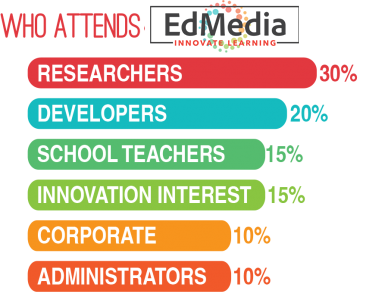
Who Attends?
Anyone can attend and/or submit proposals to present at conference. The conference is designed to engage:
- Educators in ALL disciplines
- Researchers
- Educational administrators
- Teachers
- Curriculum developers
- Technology & education companies
- Anyone with an interest in educational media
- and technology